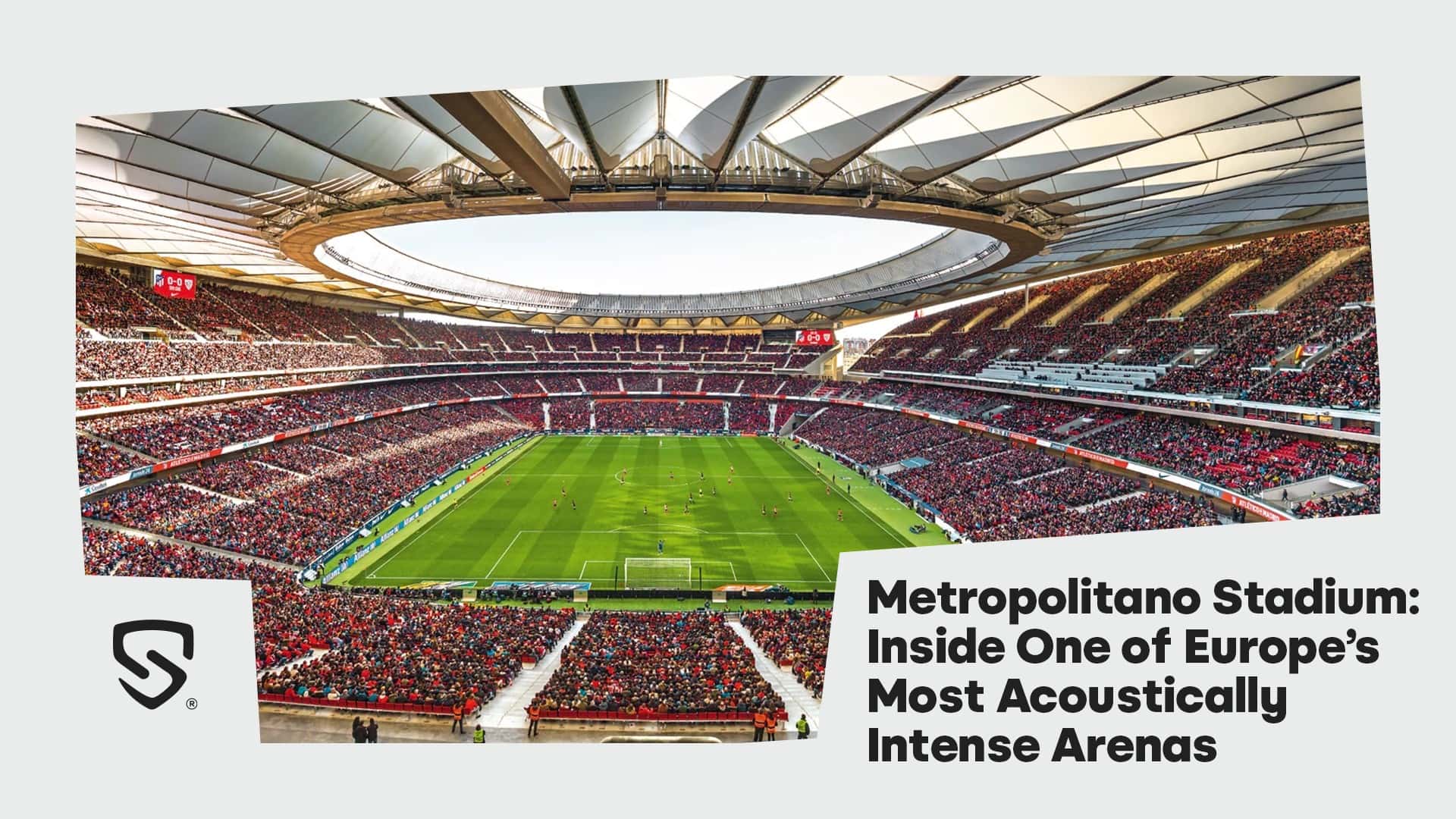
What makes a football stadium feel intimidating before a match has even begun? At Atlético de Madrid’s Metropolitano Stadium, the answer lies in the combination of passionate supporters, steep stands and a striking roof designed to help keep the crowd’s noise within the ground.
Since opening in 2017, the stadium has become a defining part of Atlético’s matchday identity. Its architecture and acoustics help explain why the venue can feel so imposing when thousands of supporters sing together.
Metropolitano Stadium Architecture and Acoustics Explained
The Riyadh Air Metropolitano, Atlético de Madrid’s home ground, opened on 16 September 2017. It replaced the Vicente Calderón as the club’s main stadium and hosted the 2019 UEFA Champions League final.
Designed by Spanish architecture practice Cruz y Ortiz, the venue combines a concrete structure with a large, lightweight roof supported by an engineered steel cable system. Its design balances spectator comfort, clear views of the pitch and a distinctive appearance.
According to Atlético de Madrid’s ($ATM) official stadium guide, the stadium has approximately 70,000 seats, with around 96% covered by the roof. The club also designed the seating arrangement to bring supporters close to the action while providing accessible routes and space between rows.
These features matter to the matchday experience. When spectators can see the action clearly and sit close to the pitch, they can feel more connected to what happens on the field. The stands also bring thousands of voices together around the playing area.
However, the Metropolitano stadium architecture and acoustics are especially interesting because the roof does more than protect spectators from the weather. Its shape also plays a role in how sound moves around the venue.
How the Metropolitano Roof Helps Keep Crowd Noise Inside
One of the stadium’s most distinctive features is its large, wave-shaped roof. Atlético’s published technical information describes a structure made from steel rings, tensioned cables and a membrane of fibreglass and polytetrafluoroethylene, commonly known as PTFE.
The roof covers approximately 46,500 square metres and reaches a maximum height of about 57 metres above the pitch. Its uneven profile gives the stadium its recognisable appearance.
The engineering team designed the roof to help reflect sound from the stands towards the lower areas of the stadium rather than allowing it to escape as easily. This can help make collective chanting more prominent within the ground.
The basic principle is straightforward. When sound waves hit a surface, some energy is reflected, some is absorbed and some may pass through or travel elsewhere. The shape and material of a surface influence what happens next.
At the Metropolitano, the roof and the surrounding stands form part of a large space where supporters’ voices can combine. When fans chant in unison, their voices create a much stronger shared sound than isolated shouts would produce.
Atlético explained this design intention in its official feature, “Get to Know All the Details of the Roofing of the New Stadium.”
That does not mean the roof automatically makes every sound louder at every seat. Acoustics vary according to where a person sits, the number of spectators present, the type of chanting and the sound system in use. Still, the design gives the stadium a physical feature intended to support its atmosphere.
Why Atlético Supporters Can Make the Stadium Feel Like a Pressure Cooker
Architecture creates the setting, but supporters bring it to life. Atlético fans are known for their strong connection to the club, and coordinated chanting can create a powerful atmosphere during important fixtures.
The stadium’s arrangement helps bring that support close to the pitch. Atlético says that some seats in the northeast corner are particularly close to the playing surface, at approximately 5.89 metres. The proximity helps supporters feel involved in the action, while players can hear the reactions from the stands.
The roof can also help the crowd’s collective voice remain present around the stadium. During a tense match, repeated chants, applause and reactions to tackles or chances can create an intense environment for both teams.
Architect Antonio Cruz has previously described the roof’s contribution to the atmosphere, comparing the effect of the stadium’s resonance to a “pressure cooker”. His comments reflect the design ambition behind the venue rather than a claim that the stadium is always louder than every other European ground.
The atmosphere also depends on the match itself. A close contest, a late goal or a major European night can prompt a stronger response from supporters than a routine game. The Metropolitano’s structure provides the setting, while the crowd determines how much energy fills it.
More Than Acoustics: The Stadium’s Technology and Design
The Metropolitano stadium architecture and acoustics form only part of the venue’s design. Atlético has also invested in lighting, digital displays and connectivity to make the stadium suitable for modern sporting and entertainment events.
The club’s official stadium information describes a 360-degree LED ribbon board and large video screens that provide match information and other content. The roof’s lighting system can also produce different colours, adding to the stadium’s visual identity during games and events.
The building has also incorporated environmental measures. These include LED lighting, solar energy for heating water and systems that collect rainwater for uses such as pitch irrigation and cleaning.
These features show how a modern stadium must serve several purposes at once. It needs to provide clear sightlines, manage large crowds, support broadcast and safety systems, and offer an enjoyable experience for spectators.
Sound design must fit into that wider picture. A stadium should create an exciting atmosphere without making public announcements difficult to understand. Researchers and acoustic designers therefore consider both the reflection of crowd noise and the clarity of emergency messages.
Is the Metropolitano One of Europe’s Loudest Stadiums?
The Metropolitano is widely recognised for its atmosphere, but calling it one of Europe’s most acoustically intense stadiums requires care. A reliable ranking would need comparable sound measurements taken under similar conditions at different grounds.
The size of a crowd alone does not establish which stadium is loudest. Measurements can change according to attendance, the position of the microphone, the duration of chanting and whether the sound is measured inside the stands or outside the venue.
The stadium’s roof was designed to help reflect crowd noise, and Atlético’s supporters can create a formidable matchday atmosphere. Those are well-supported points. Without comparable independent measurements, however, it would be misleading to claim that the Metropolitano definitively ranks above other major European stadiums for loudness.
What makes the venue distinctive is the combination of its roof engineering, close seating arrangement and passionate home support. Together, these features help create an environment that feels connected to Atlético’s identity.
Why the Metropolitano’s Design Matters to Atlético de Madrid
For Atlético, the Metropolitano is more than a place to play football. It is a home designed to bring supporters closer to the team while giving the club a modern venue for major sporting and entertainment events.
Its roof protects most spectators and was engineered with crowd noise in mind. Its seating layout supports clear views, while its lighting and digital systems add another layer to the matchday experience.
The relationship between design and atmosphere is the key story. The building cannot manufacture passion, but it can shape how that passion is experienced. When Atlético supporters fill the stands and sing together, the stadium’s architecture helps provide the setting for a memorable night.
That is why Metropolitano stadium architecture and acoustics deserve attention. The venue’s reputation comes not from one feature alone, but from the way its engineering, layout and supporters combine to make Atlético’s home ground feel unmistakably its own.